Pedagogy and Embodiment
The contemporary world through the lens of the media is full of war, sick with authority, domination and white supremacy. Many of our current tools for interaction, social media and AI in particular, experienced alone and anonymously, can be alienating. They can simulate human exchange, offer representations of fulfilled desire, divert us, or provide an inert and temporary escape from loneliness. But they cannot replace human contact and creative exchange. This contemporary situation is on my mind when I formulate teaching strategies.
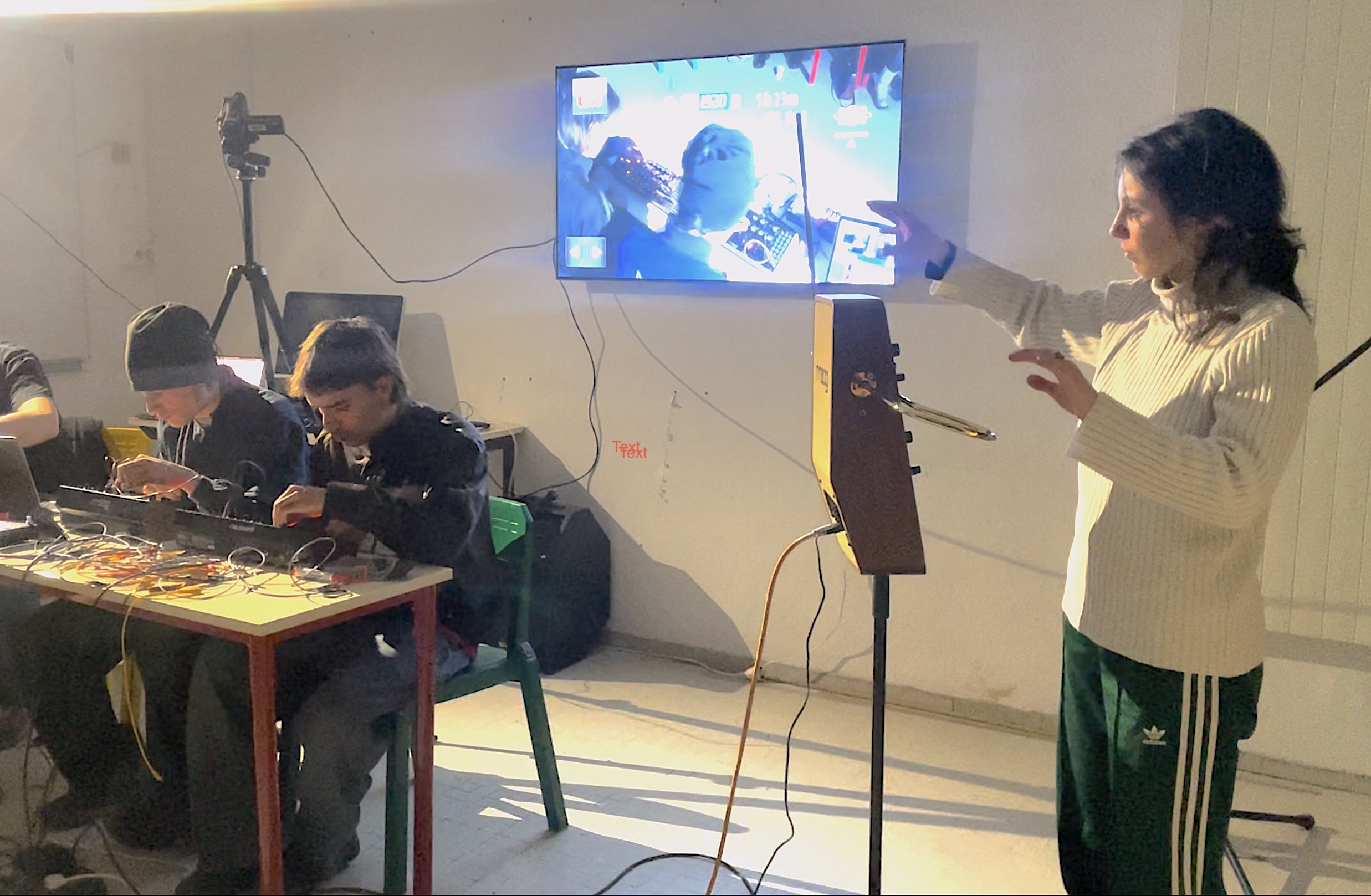
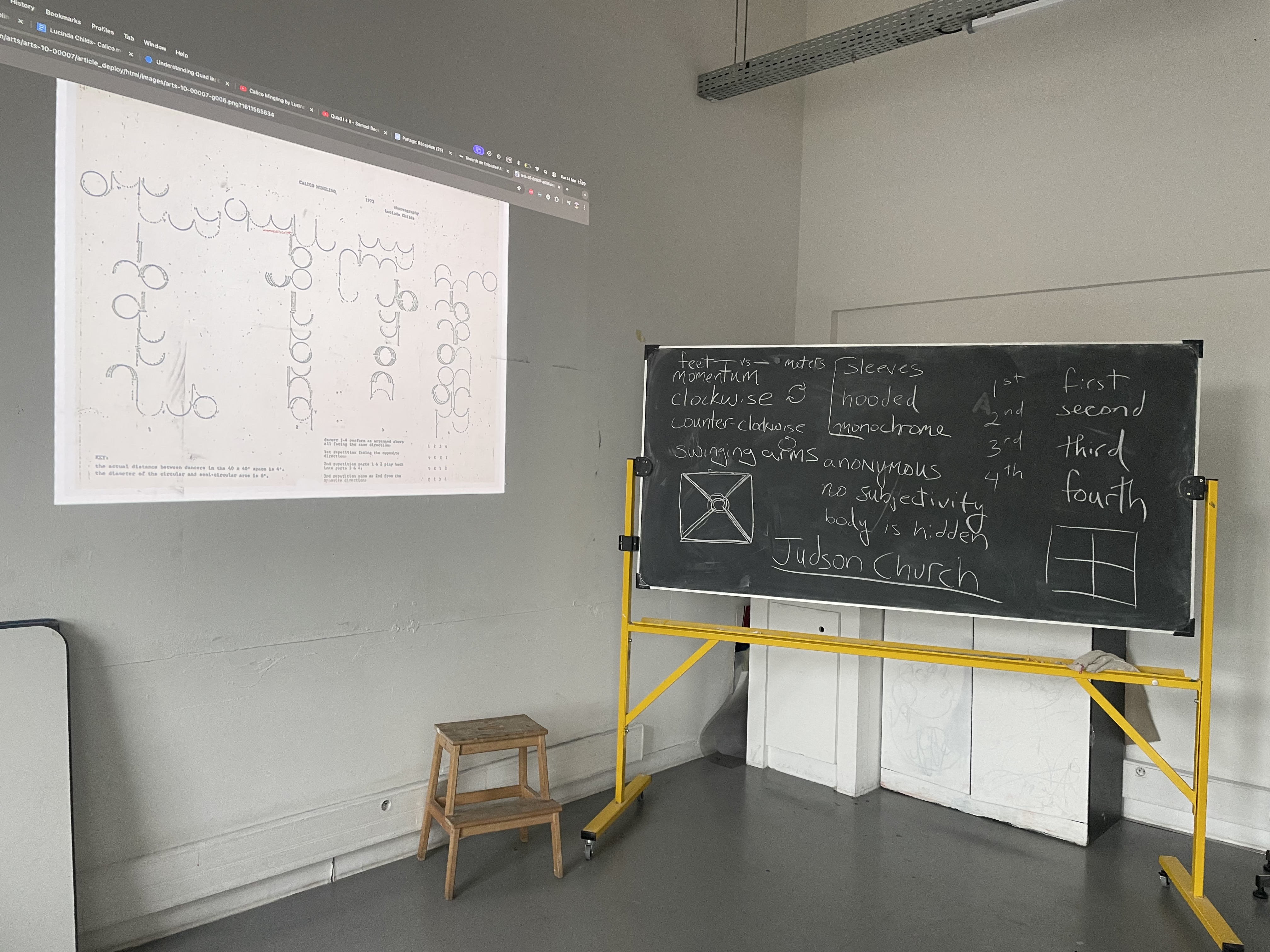
As an arts and language educator, I try to encourage and evoke students’ latent curiosity and support critical thought in an environment that nurtures reflection and discussion. I use materials most familiar to me such as artist protocols, choreographic and theater exercises, music and musical instruments, science fiction literature and theoretical texts in the various courses that I teach. These tools create context and are starting points for action and inquiry.
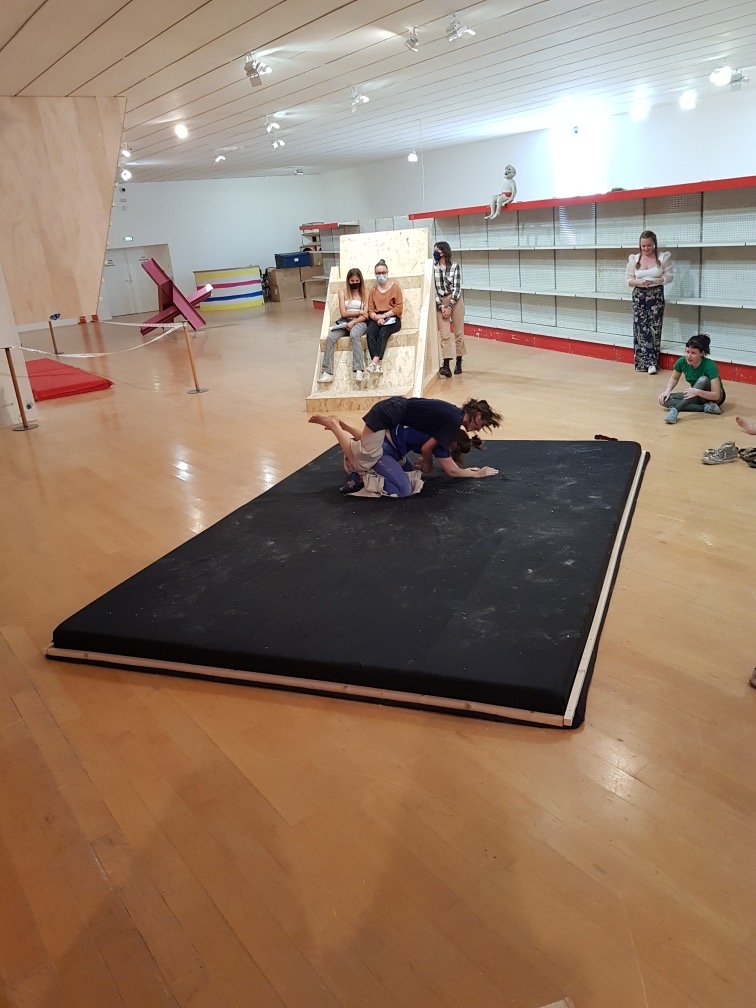
The experience of embodiment is important to my teaching; that special relationship of having a body in relationship to other bodies (living or non) and to spaces inside or outside of the classroom. I do believe embodied experiences are necessary to learning, through a convergence of the senses and through meaningful actions that change our perspective and enrich our language. Experiencing things together gives us the opportunity to relate thought and language to a precise shared moment.
I reject systems of authority and domination in education. I am conscious of the inherent dynamic of power that pervades teacher student relationships and must be constantly questioned. I believe we must avoid coercive tactics, mistaken for motivational tools, in education. I reject a transactional relationship between student and teacher, where a student receives something from a teacher and must file it away in order to repeat it later. I believe that through embodiment, whether through the senses, the voice or actual movement, students learn through deep reflection that responds to direct feeling and intuition.
Our locus is our body. Without exploring that central point from which things are experienced how can we abstract or project ourselves somewhere beyond it without losing ourselves entirely? The contemporary world is staged for an adaptive state of dissociation. Education must be rooted in the building of trusting relationships with other humans and with other living things in our environment, in our communities, through shared experience.
As Paulo Freire states in Pedagogy of the Oppressed, “Education is thus constantly remade in the praxis….problem-posing education, which accepts neither a "well-behaved" present nor a predetermined future—roots itself in the dynamic present and becomes revolutionary.”
A large part of teaching is formulating questions, and teaching how to formulate questions and then rather than providing or anticipating conclusions, allowing the group to follow a line of thought. As Freire points out it is not about reaching a fixed point of permanence, an endpoint determined by a quantified moment in time, it is allowing the subject of a class to live its own life through the group, becoming actionable or leading to some other even more important subject, not ending but creating new beginnings.
While observing and listening, we cultivate patience and challenge fixed perspectives. Patience in a pedagogical context is waiting ….it is sometimes being silent, letting things happen, a flow, watching who leads, who hides, sometimes leading focus back to the subjects by asking a question, sometimes allowing the subjects to move elsewhere, to determine a stronger objective, perhaps one the teacher had not thought of or prepared. I think subjects here have a double meaning, the subjects are both the people and the issues they undertake together.
In Fred Moten’s Anassignment Letters he writes, Because what if intellectual practice is irreducibly chor(e)ographic? What if you have to move in order to map? What if reflection is also a matter of reflex? What if the animation of flesh is fundamental to reflection? What if reflection and reflexion and refleshment and refreshment are one and the same? Deeper still, what if the movement in question is, at once, collective and in concert, but also disruptive or deconstructive of the idea of a certain coherence or integrity of the single body/being? - from Stolen Life
In this essay, Moten addresses the problem of the assignment, about how one assignment leads to another assignment, as a pretext for a fixed coercive relationship that fulfills an administrative function and is alienating. He instead formulates learning as fugitivity, something that moves away and stays open, like Freire he is talking about how education can make change possible. Again, the body is central to this argument but here he emphasizes that perhaps even the body itself is not singular in the context of learning. He formulates a teaching practice that does not reject subjectivity (that of the student or the teacher) but suggests that there is perhaps something more, something better, in something common.
I mention Freire and Moten as inspirations for my teaching but I am moved and inspired by so many other teachers and their practices, artist/theorist/teachers who are known to me personally as collaborators/friends/advisors or through their protocols, writings, or through their students who have spoken fondly of them. To name a few there are Pauline Oliveros, Tony Conrad, Beth Stephens, Vir Andres Hera, Thom Donovan, Julie Portier, Maxime Thieffine, Anne Kawala, Jagna Ciuchta, Tim Shaw, and Elisabeth Schwartz.